



The highly anticipated matchup between the Indianapolis Colts and the Seattle Seahawks was a display of football at its finest, combining strategic coaching, athletic prowess, and individual brilliance. Fans across the nation eagerly tuned in to watch the clash, and the colts vs seahawks match player stats reveal the depth of talent on both sides. Every yard gained, every tackle made, and every pass completed carried significance, shaping the momentum of this thrilling contest.
From the opening kickoff, both teams demonstrated their commitment to executing game plans flawlessly, and the statistics highlight the remarkable performances that defined this matchup. The Colts showcased a combination of youth and precision on offense, while the Seahawks relied on their experienced roster and balanced attack to challenge their visitors. By analyzing these statistics, fans can gain a deeper appreciation of the strategies and individual contributions that influenced the final outcome. Whether it was a quarterback under pressure, a running back breaking tackles, or a defensive back creating a turnover, each player left a mark that made this game memorable.
Game Overview and Match Context
Lumen Field buzzed with excitement as the Seahawks hosted the Colts for what promised to be an intense interconference duel. Both teams entered the game with objectives that went beyond a simple win-loss record. For the Colts, this matchup offered an opportunity to test their offensive schemes against a seasoned NFC defense, while the Seahawks aimed to assert their home-field advantage and showcase their ability to control both sides of the ball.
The atmosphere inside the stadium was amplified by fans eager to see their team perform at peak efficiency. Seattle’s passionate 12th Man provided energy and intensity that challenged Indianapolis to remain focused and disciplined. Weather conditions were typical for the Pacific Northwest, with overcast skies adding a dramatic backdrop to the unfolding contest. Pre-game discussions centered on quarterback efficiency, injury reports, and tactical matchups, with analysts predicting a closely fought battle.
Seattle won the coin toss and opted to receive, signaling an aggressive approach from the outset. Former players from both franchises attended the game, reinforcing the rich history and legacy of both teams. Optimal weather conditions allowed both offenses to execute complex plays without concern for rain or wind, setting the stage for a contest that would test skill, stamina, and strategic thinking.
Quarterback Duel and Passing Statistics
The colts vs seahawks match player stats naturally highlight the quarterback performances, with both signal callers delivering exceptional games. Indianapolis quarterback Anthony Richardson demonstrated remarkable poise, showing improved accuracy and timing, particularly on deep passes that required precise touch. He spread the ball effectively among his receivers, ensuring the Colts maintained sustained drives and consistently converted crucial third downs.
On the other sideline, Geno Smith showcased his dual-threat capabilities, combining a strong arm with the agility to extend plays with his legs. His ability to scramble under pressure and find open receivers contributed to several explosive plays that kept Seattle’s offense ahead of the chains. Both quarterbacks maintained composure under relentless defensive pressure, minimizing turnovers in the first half while creating opportunities for their teammates to shine.
Richardson’s mobility forced the Seahawks to adapt with a linebacker spy, opening running lanes for Indianapolis backs. Meanwhile, Smith’s pre-snap recognition allowed Seattle to adjust protections against potential blitzes, giving his receivers cleaner windows for successful completions. The matchup highlighted both the tactical and physical demands placed on quarterbacks in high-stakes games.
| Team | Player Name | Completions | Attempts | Passing Yards | Touchdowns | Interceptions | Quarterback Rating |
|---|---|---|---|---|---|---|---|
| Colts | Anthony Richardson | 23 | 38 | 295 | 2 | 1 | 89.7 |
| Colts | Gardner Minshew | 2 | 3 | 24 | 0 | 0 | 87.5 |
| Seahawks | Geno Smith | 28 | 41 | 327 | 3 | 1 | 102.4 |
| Seahawks | Drew Lock | 0 | 0 | 0 | 0 | 0 | 0.0 |
Running Back Production and Ground Attack
The rushing game proved instrumental in shaping the contest’s narrative. Indianapolis employed a multi-back approach, keeping runners fresh against Seattle’s formidable front seven. Zack Moss led the Colts with patience, vision, and power, consistently turning minimal yardage into significant gains. Backup runners provided support by catching passes and contributing in pass protection.
Seattle countered with Kenneth Walker III, a versatile back blending strength and speed. His ability to break tackles and generate yards after contact made him a constant threat, particularly in goal-line scenarios. Seahawks offensive linemen executed blocks with precision, creating lanes for runners and setting up play-action opportunities later. The ground game for both teams emphasized the importance of controlling tempo, sustaining drives, and balancing the offensive attack.
| Team | Player Name | Carries | Rushing Yards | Average Yards | Longest Run | Rushing Touchdowns | Receptions | Receiving Yards |
|---|---|---|---|---|---|---|---|---|
| Colts | Zack Moss | 17 | 78 | 4.6 | 18 | 1 | 3 | 22 |
| Colts | Jonathan Taylor | 8 | 42 | 5.3 | 14 | 0 | 2 | 18 |
| Seahawks | Kenneth Walker III | 19 | 102 | 5.4 | 31 | 1 | 4 | 35 |
| Seahawks | Zach Charbonnet | 7 | 31 | 4.4 | 9 | 0 | 2 | 16 |
Wide Receivers and Passing Game Targets
Wide receivers played a pivotal role, with both teams relying on explosive plays and precise route execution. Michael Pittman Jr. led Indianapolis with consistency, making contested catches and accumulating significant yardage. DK Metcalf demonstrated why he is considered one of the league’s premier deep threats, combining size and speed to dominate matchups. Supporting receivers contributed in key situations, providing options for quarterbacks and extending drives.
| Team | Player Name | Receptions | Targets | Receiving Yards | Average Yards | Longest Catch | Touchdowns |
|---|---|---|---|---|---|---|---|
| Colts | Michael Pittman Jr. | 8 | 12 | 104 | 13.0 | 28 | 1 |
| Colts | Josh Downs | 6 | 9 | 78 | 13.0 | 22 | 0 |
| Colts | Alec Pierce | 4 | 7 | 63 | 15.8 | 35 | 0 |
| Seahawks | DK Metcalf | 7 | 11 | 112 | 16.0 | 42 | 1 |
| Seahawks | Tyler Lockett | 8 | 10 | 89 | 11.1 | 24 | 1 |
| Seahawks | Jaxon Smith-Njigba | 6 | 8 | 71 | 11.8 | 19 | 1 |
Tight End Contributions and Impact
Tight ends were critical for both teams in red zone situations and intermediate passing attacks. Kylen Granson scored his first touchdown of the season for Indianapolis, while Noah Fant contributed athleticism that stressed the Colts’ defensive coverage. Mo Alie-Cox and Will Dissly provided excellent blocking, ensuring successful running plays and protection for their quarterbacks.
| Team | Player Name | Receptions | Targets | Receiving Yards | Average Yards | Longest Catch | Touchdowns |
|---|---|---|---|---|---|---|---|
| Colts | Kylen Granson | 3 | 4 | 34 | 11.3 | 16 | 1 |
| Colts | Mo Alie-Cox | 2 | 3 | 24 | 12.0 | 13 | 0 |
| Seahawks | Noah Fant | 4 | 5 | 48 | 12.0 | 21 | 0 |
| Seahawks | Will Dissly | 3 | 4 | 37 | 12.3 | 18 | 0 |
Defensive Standouts and Game-Changing Plays
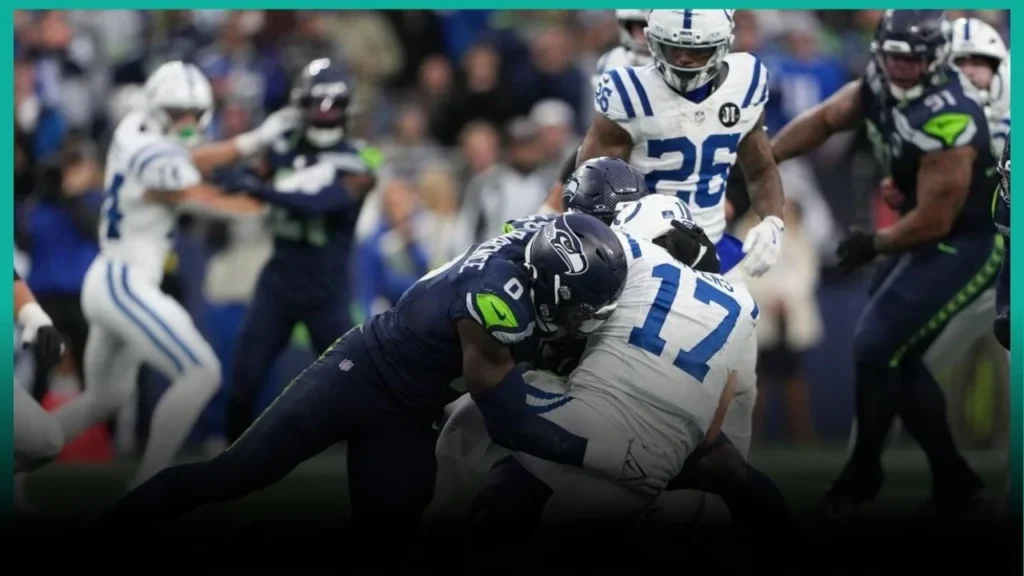
Both defenses made critical contributions. Zaire Franklin led the Colts with 11 tackles, while Bobby Wagner anchored the Seahawks’ defense with 12 stops. DeForest Buckner applied consistent pressure in the interior, and Devon Witherspoon disrupted multiple passing lanes. Turnovers and sacks at pivotal moments demonstrated how defensive execution can dictate game momentum.
| Team | Player Name | Tackles | Solo Tackles | Assisted Tackles | Sacks | Tackles For Loss | Pass Deflections | Interceptions |
|---|---|---|---|---|---|---|---|---|
| Colts | Zaire Franklin | 11 | 7 | 4 | 0 | 1 | 1 | 0 |
| Colts | DeForest Buckner | 5 | 3 | 2 | 1.5 | 2 | 1 | 0 |
| Colts | Kenny Moore II | 8 | 6 | 2 | 0 | 0 | 2 | 1 |
| Seahawks | Bobby Wagner | 12 | 8 | 4 | 0 | 2 | 1 | 0 |
| Seahawks | Devon Witherspoon | 7 | 6 | 1 | 1 | 1 | 3 | 0 |
| Seahawks | Julian Love | 9 | 6 | 3 | 0 | 0 | 1 | 1 |
Special Teams Impact and Field Position Battle
Special teams influenced the contest’s flow. Colts kicker Matt Gay converted two field goals, including a clutch 53-yarder, while punter Rigoberto Sanchez consistently pinned the Seahawks deep. Seattle responded with strong performances from Jason Myers and Michael Dickson, complemented by DeeJay Dallas’ explosive kick returns. Coverage units from both sides limited field position advantages, emphasizing the importance of special teams in tight games.
| Team | Player Name | Stat Category | Performance Details |
|---|---|---|---|
| Colts | Matt Gay | Field Goals | 2/2 made, long of 53 yards |
| Colts | Rigoberto Sanchez | Punts | 4 punts, 48.5 yard average, 2 inside 20 |
| Colts | Isaiah McKenzie | Kick Returns | 2 returns, 52 yards, long of 28 |
| Seahawks | Jason Myers | Field Goals | 3/3 made, long of 48 yards |
| Seahawks | Michael Dickson | Punts | 3 punts, 50.3 yard average, 1 inside 20 |
| Seahawks | DeeJay Dallas | Kick Returns | 3 returns, 89 yards, long of 42 |
Turnover Battle and Momentum Swings
Turnovers were perhaps the single most impactful factor in this tightly contested matchup, and the colts vs seahawks match player stats show how they swung momentum in critical moments. Kenny Moore II’s interception of Geno Smith came in the third quarter at a point when Seattle appeared poised to extend their lead. The cornerback read the quarterback’s eyes perfectly, jumping the route and securing the ball to halt a promising drive.
This play not only energized the Colts sideline but also gave Indianapolis excellent field position, allowing them to capitalize with a touchdown on the ensuing possession. Seattle, however, quickly answered with a forceful defensive response. Their front-line defenders stripped the ball from a Colts runner near midfield, and the fumble recovery directly led to a Seahawks touchdown that extended their lead and dampened the momentum for Indianapolis. These exchanges highlighted the fine margins of professional football, where a single misstep or brilliant defensive read can alter the trajectory of the game.
The turnover battle demonstrated the absolute importance of ball security and opportunistic defense; teams that protect the football while exploiting opponents’ mistakes consistently gain a competitive edge. Ultimately, the Seahawks’ ability to convert their takeaway into points proved decisive in determining the outcome, underscoring that in the NFL, turnovers are often the difference between victory and defeat.
Time of Possession and Drive Efficiency
Time of possession was a critical component of each team’s strategy, and the statistical breakdown reveals two contrasting approaches that defined the game’s rhythm. The Colts emphasized long, methodical drives, maintaining control of the football for nearly 33 minutes and running a total of 72 plays. Their approach relied heavily on a combination of short, high-percentage passes and a balanced rushing attack, aiming to sustain drives, keep their defense rested, and limit Seattle’s opportunities to generate explosive plays.
By systematically moving the chains, Indianapolis was able to dominate portions of the game clock, demonstrating patience and discipline in their offensive philosophy. In contrast, Seattle adopted a more explosive approach, prioritizing high-impact plays that required fewer snaps to reach scoring positions. The Seahawks averaged nearly eight yards per play, showing that their offense could strike quickly and decisively, often converting a few plays into touchdowns without consuming much time.
This contrast in offensive philosophies created a compelling dynamic: the Colts attempted to grind out the clock and force a physical contest, while Seattle sought to score efficiently and rely on their big-play capability to dictate momentum. The strategic tug-of-war between sustained drives and explosive scoring opportunities highlighted the importance of balancing tempo with efficiency, and it also had a measurable effect on defensive fatigue, particularly late in the game.
Third Down Conversions and Situational Football
Third-down situations often separate average teams from elite performers, and this matchup showcased the importance of situational football in determining the ultimate outcome. The Colts converted 50 percent of their third-down opportunities, extending drives with precise route execution, timing-based passes, and effective quarterback decision-making under pressure.
On longer third downs, receivers displayed discipline in finding soft spots within zone coverage, allowing Anthony Richardson to complete key passes that kept chains moving. Conversely, Seattle converted 54 percent of third downs, with Geno Smith’s mobility providing an additional weapon when traditional passing lanes were closed. His ability to scramble, navigate the pocket, and throw accurately on the move extended several drives that might otherwise have stalled.
Both defenses, meanwhile, demonstrated situational awareness and resilience, frequently forcing punts on critical third downs while remaining disciplined in red zone situations. The statistics underline that successful execution in these high-leverage moments can dictate not only possession control but also the psychological momentum of a game. Ultimately, the slightly better third-down efficiency of the Seahawks allowed them to sustain crucial drives that translated into points, showcasing the tactical nuance that situational football demands.
Red Zone Efficiency and Scoring Opportunities
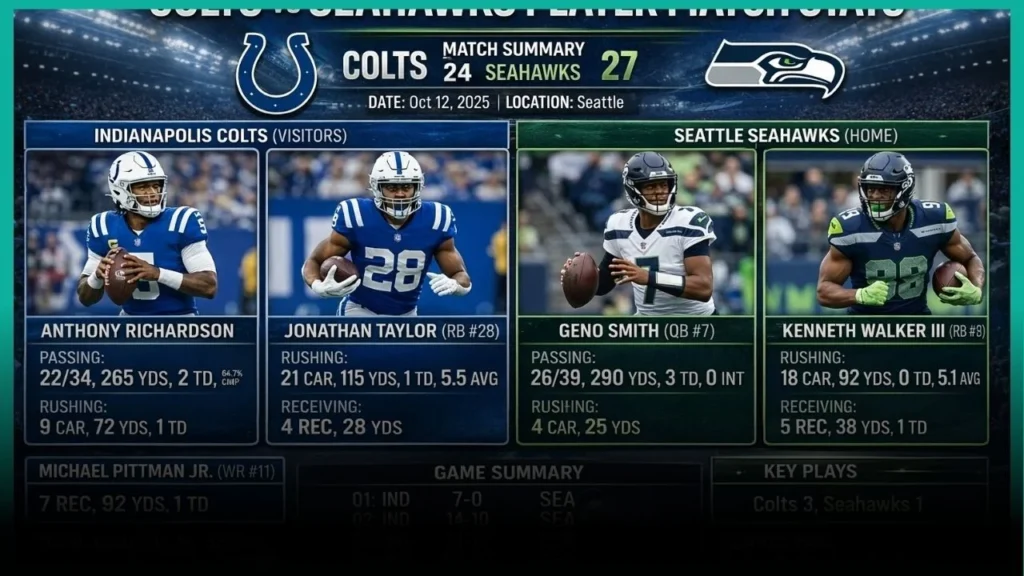
Performance in the red zone is a decisive factor in NFL games, and this matchup offered an instructive look at how both teams maximized scoring opportunities within a compressed field. The Colts entered the red zone four times, converting three trips into touchdowns, a testament to both their creative play-calling and disciplined execution.
Anthony Richardson demonstrated excellent awareness, consistently avoiding high-risk throws while finding receivers in tight spaces and exploiting mismatches against linebackers. Running backs like Zack Moss contributed crucial short-yardage gains, powering through contact and allowing Indianapolis to punch the ball into the end zone. Seattle, however, exhibited perfect red zone efficiency, scoring on all three of their trips into Colts territory.
Geno Smith’s mobility added a unique dimension, enabling quarterback draws and escape routes that forced defenders to hesitate and opened passing windows to tight ends like Noah Fant. Both teams relied on a combination of timing, precision, and athleticism to convert these opportunities into points, illustrating that while yards gained between the 20-yard lines matter, the ability to execute when the field shrinks is what ultimately separates a competitive team from a dominant one.
Key Matchups and Individual Battles
Football is ultimately a game of individual battles, and the Colts vs Seahawks match player stats reveal how these micro-level confrontations shaped the macro outcome. On the offensive line, Colts tackles faced the Seahawks’ explosive edge rushers, testing technique, hand placement, and footwork on every snap. Meanwhile, Seattle’s first-round pick Charles Cross neutralized Indianapolis’ pass rushers with quick feet and upper-body strength, maintaining pocket integrity for critical passes.
Guards and interior linemen engaged in constant physical chess matches, with Quenton Nelson pulling to lead the way on key runs while Seattle’s interior defenders attempted to disrupt timing and push runners back. The wide receiver versus cornerback matchups were equally telling, with receivers like Michael Pittman Jr., DK Metcalf, and Tyler Lockett forcing defensive backs to fight for positioning at every turn. Safety play proved vital, as both Julian Love and Rodney Thomas executed open-field tackles and coverage responsibilities that prevented long gains and potential momentum swings.
These one-on-one battles, though often invisible to casual viewers, directly influenced which team controlled the line of scrimmage, dictated tempo, and created opportunities for explosive plays. In essence, the outcome of the game was as much about winning individual matchups as it was about executing team-wide strategies, reaffirming the NFL’s reputation as a sport where attention to detail, skill, and persistence on every snap make all the difference.
Final Game Analysis and Key Takeaways
The colts vs seahawks match player stats illustrate a contest filled with excitement, skill, and strategic depth. Seattle’s explosive passing game, led by Geno Smith, combined with Kenneth Walker III’s consistent running attack, created challenges the Colts struggled to solve. Indianapolis displayed promise with Anthony Richardson’s passing and disciplined running, but Seattle’s ability to capitalize on big plays and turnovers ultimately determined the result. Both teams demonstrated resilience, professionalism, and a high level of play that fans will remember for seasons to come.
FAQs
Who won the Colts vs Seahawks game based on player statistics?
The Seahawks won the matchup, with statistics showing balanced offensive production, critical defensive stops, and red zone efficiency that proved decisive.
Which quarterback had better stats in the Colts vs Seahawks game?
Geno Smith posted slightly better stats with 327 passing yards and three touchdowns, while Anthony Richardson threw for 295 yards and two scores, showing strong potential.
How many rushing yards did Kenneth Walker III gain against the Colts?
Kenneth Walker III rushed for 102 yards on 19 carries, scoring one touchdown and generating significant yards after contact throughout the game.
Did any defensive players record interceptions in this game?
Yes. Kenny Moore II of the Colts intercepted a pass, and Julian Love of the Seahawks also recorded an interception, shifting momentum for both teams.
Which receiver led all players in receiving yards during the game?
DK Metcalf led with 112 receiving yards and one touchdown, making multiple contested catches and demonstrating dominance against Colts defenders.
How did the Colts running backs perform against Seattle’s defense?
Zack Moss led with 78 rushing yards and a touchdown, while Jonathan Taylor contributed 42 yards on eight carries and 18 receiving yards, showing the Colts’ backfield depth.
What was the most crucial play of the game according to statistics?
Seattle’s fourth-quarter fumble recovery led directly to a touchdown, swinging momentum and effectively securing the win.
How did third down conversions affect the final outcome?
Seattle converted 54% of third downs, extending drives and putting Indianapolis’ defense under stress. Colts converted 50%, showing competitiveness but ultimately slightly trailing in efficiency.
VISIT MORE : Circle Magazine