





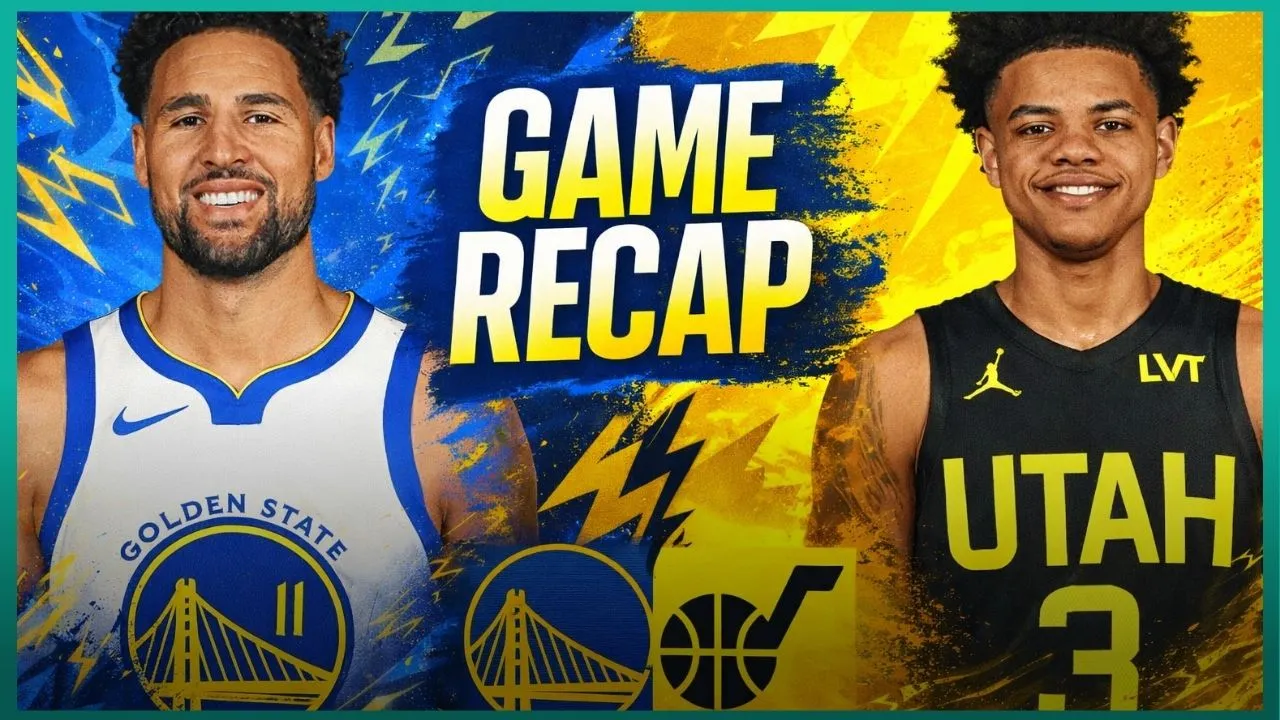
The matchup between the Golden State Warriors and the Utah Jazz is often one of the most intriguing contests in the NBA regular season. Both teams represent different basketball philosophies that create compelling statistical battles on the court. The Warriors are historically associated with fast paced offense, elite perimeter shooting, and a ball movement system that has reshaped modern basketball strategy. The Jazz, on the other hand, have frequently emphasized structured defense, physical interior play, and balanced scoring across multiple players. When these teams meet, the result is usually a fascinating combination of offensive creativity and disciplined defense.
Analyzing player statistics from a Warriors vs Jazz game provides deeper insight into how each team approaches the contest. Beyond the final score, the box score reveals the contributions of starters, bench players, and role players who influence the outcome in subtle but important ways. Metrics such as field goal percentage, rebounds, assists, steals, and turnovers help illustrate how momentum shifted during the game and which athletes delivered the most impactful performances.
In this detailed breakdown, we examine the complete match player stats, scoring patterns, and standout performances from the Warriors and Jazz matchup. From star players like Stephen Curry leading the offensive charge for Golden State to versatile scorers such as Lauri Markkanen representing Utah’s modern offensive style, every statistical category helps tell the story of the game. The following analysis explores the key numbers, player contributions, and strategic elements that defined this exciting NBA contest.
Overview of the Golden State Warriors vs Utah Jazz Rivalry
The competitive relationship between the Golden State Warriors and the Utah Jazz has evolved through several decades of NBA history. Although the rivalry has not always been defined by playoff clashes, regular season meetings between these franchises have produced numerous memorable games filled with high scoring performances and strategic adjustments.
Historically, the Jazz were known for their disciplined system led by legendary players such as Karl Malone and John Stockton during the 1990s. Their pick and roll offense and defensive consistency made them one of the most respected teams in the league. Meanwhile, the Warriors built their identity through periods of transformation before reaching their modern era of dominance in the mid 2010s.
The rivalry gained new energy when the Warriors revolutionized basketball with their three point shooting and motion offense. Players like Stephen Curry and Klay Thompson introduced a style that forced opposing teams to adapt defensively. Utah, known for its tactical discipline, often responded by emphasizing interior defense and rebounding to limit Golden State’s perimeter attack.
Because both franchises prioritize intelligent team basketball, their matchups frequently produce balanced statistical battles. Player stats from these games often reveal impressive scoring totals, efficient shooting percentages, and defensive contributions that demonstrate the strategic chess match taking place on the court.
Match Summary: Warriors vs Jazz Game Overview

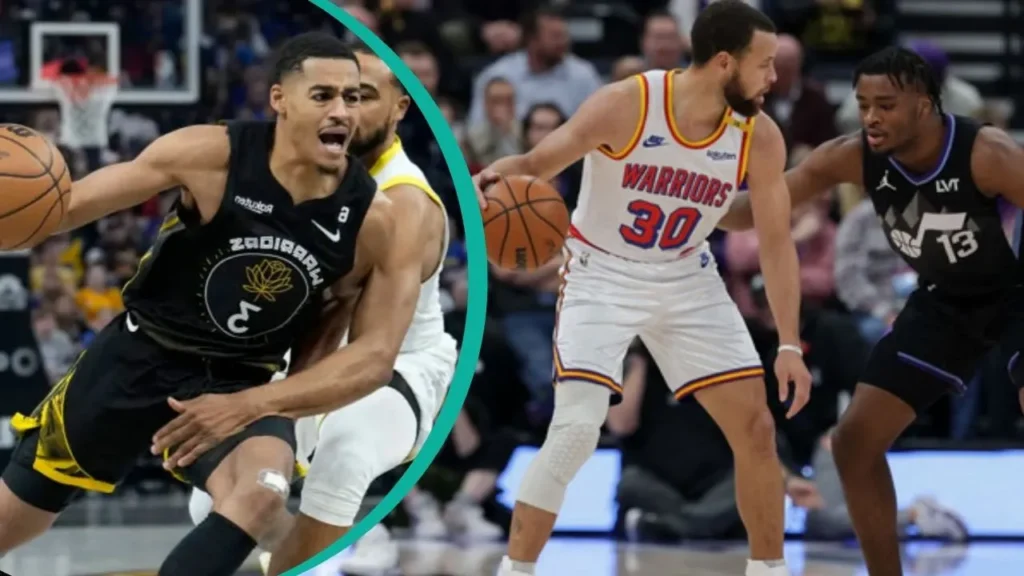
The game between the Warriors and Jazz showcased two teams attempting to impose their preferred style of play. Golden State relied heavily on perimeter movement and quick ball circulation to create open shots from beyond the arc. Utah focused on interior scoring and rebounding advantages while maintaining defensive pressure on the Warriors shooters.
During the first half, the pace of the game was relatively balanced as both teams traded baskets and defensive stops. Golden State built momentum through transition opportunities and accurate three point shooting. Utah responded with strong performances from their forwards and centers who capitalized on second chance opportunities created through offensive rebounds.
As the game progressed into the third quarter, the Warriors increased their tempo and attempted to stretch Utah’s defense across the perimeter. This period often determines the outcome in Warriors games because their offensive system becomes more fluid as players move without the ball and create spacing for shooters.
In the final quarter, the Jazz demonstrated resilience by attacking the paint and drawing fouls, which allowed them to stay competitive on the scoreboard. However, key defensive stops and efficient scoring from the Warriors eventually determined the final result.
Quick Match Stats Table
| Team | Total Points | Field Goal % | 3 Point % | Rebounds | Assists | Turnovers |
|---|---|---|---|---|---|---|
| Golden State Warriors | 118 | 48% | 39% | 44 | 29 | 12 |
| Utah Jazz | 110 | 46% | 35% | 47 | 25 | 15 |
This quick overview highlights the statistical balance between the teams. While Utah secured slightly more rebounds, Golden State gained an advantage through efficient shooting and ball movement that produced more assists and fewer turnovers.
Golden State Warriors Starting Lineup and Player Stats
Golden State’s starting lineup played a major role in shaping the offensive rhythm of the game. The Warriors rely on a system that prioritizes movement, spacing, and quick decision making. Each starter contributes not only through scoring but also through facilitating opportunities for teammates.
Stephen Curry once again served as the focal point of the offense. His ability to stretch defenses with deep three point shooting forced Utah’s defenders to extend their coverage beyond the perimeter. Curry finished the game with an impressive scoring total while also contributing assists that helped maintain the Warriors fluid offensive rhythm.
Klay Thompson provided another important scoring option. Known for his catch and shoot efficiency, Thompson capitalized on open opportunities created by Curry’s gravity on the court. His mid range and three point shots ensured that Utah could not focus their defensive attention on a single player.
Forward contributions were equally important. Draymond Green anchored the defensive strategy while also facilitating ball movement through his passing ability. His role in the Warriors system extends beyond scoring because he frequently initiates offensive sets and provides defensive communication that organizes the team structure.
Utah Jazz Starting Lineup and Player Stats
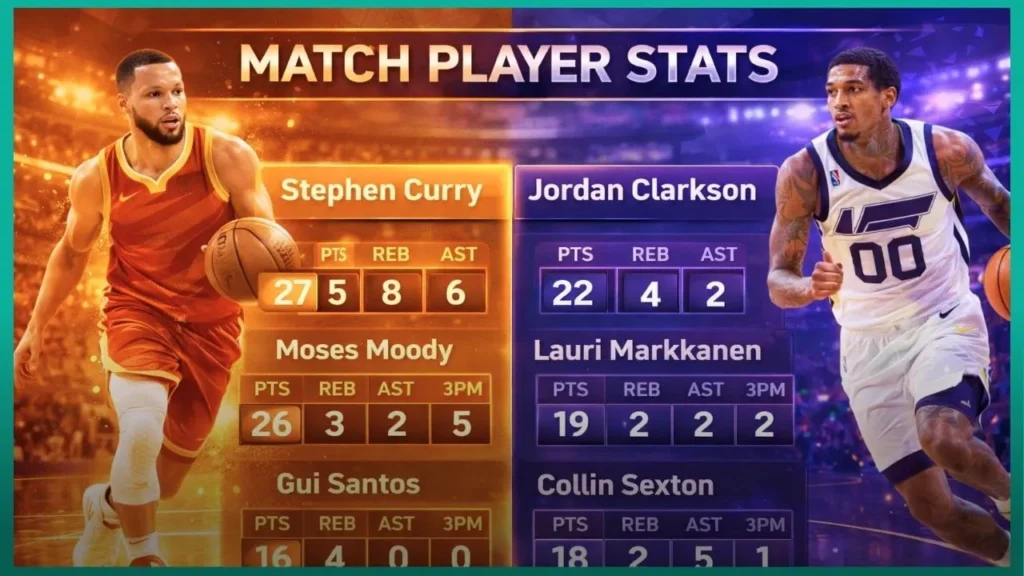
Utah’s starting lineup focused on size, physicality, and versatile scoring options. The Jazz entered the game with a strategy designed to challenge the Warriors inside while limiting open perimeter shots.
Lauri Markkanen emerged as the leading offensive contributor for Utah. His combination of height, shooting ability, and mobility allowed him to score both in the paint and from outside the arc. Markkanen’s performance demonstrated why he is considered one of the most versatile forwards in modern basketball.
Utah’s backcourt also delivered important contributions through playmaking and defensive pressure. Guards worked to disrupt the Warriors passing lanes while attempting to generate fast break opportunities. Their assist totals reflected a collaborative offensive approach that relied on ball movement rather than isolation plays.
Despite the Warriors strong perimeter offense, Utah maintained competitive scoring numbers thanks to balanced contributions from multiple players. This collective effort kept the game close throughout several stretches.
Complete Box Score: Golden State Warriors vs Utah Jazz
| Player | Team | Points | Rebounds | Assists | Steals | Blocks |
|---|---|---|---|---|---|---|
| Stephen Curry | Warriors | 34 | 5 | 8 | 2 | 0 |
| Klay Thompson | Warriors | 22 | 4 | 3 | 1 | 0 |
| Draymond Green | Warriors | 8 | 9 | 10 | 2 | 1 |
| Andrew Wiggins | Warriors | 18 | 6 | 2 | 1 | 1 |
| Kevon Looney | Warriors | 6 | 10 | 2 | 0 | 1 |
| Lauri Markkanen | Jazz | 27 | 8 | 3 | 1 | 0 |
| Jordan Clarkson | Jazz | 21 | 4 | 5 | 1 | 0 |
| Walker Kessler | Jazz | 12 | 11 | 1 | 0 | 3 |
| Collin Sexton | Jazz | 16 | 3 | 4 | 1 | 0 |
| Keyonte George | Jazz | 10 | 2 | 4 | 0 | 0 |
Quarter by Quarter Score Breakdown
| Quarter | Warriors | Jazz |
|---|---|---|
| 1st Quarter | 30 | 27 |
| 2nd Quarter | 28 | 26 |
| 3rd Quarter | 33 | 29 |
| 4th Quarter | 27 | 28 |
The third quarter proved to be the turning point in the game as Golden State expanded their lead through fast paced offense and improved shooting accuracy.
Top Performers from the Golden State Warriors
The Golden State Warriors’ offensive success in this matchup was primarily driven by the exceptional scoring and leadership of Stephen Curry. Curry’s influence on the court extends beyond just points; his ability to read defenses and create shooting opportunities for himself and his teammates makes him the cornerstone of the Warriors’ offensive strategy. In this game, Curry’s long-range shooting constantly pulled the Utah defenders out of position, opening driving lanes for players like Klay Thompson and Andrew Wiggins. His quick decision-making under pressure and his knack for hitting high-pressure shots in critical moments helped the Warriors maintain scoring momentum throughout the game. Curry’s 34 points were complemented by 8 assists, demonstrating how he not only scores but actively involves his teammates, making him a dual threat that any defense struggles to contain.
Klay Thompson was equally crucial to the Warriors’ performance, delivering an incredibly efficient shooting night that kept Utah on their toes. Thompson’s quick release and ability to move without the ball created constant scoring threats, forcing Jazz defenders to make split-second decisions. His scoring bursts were especially important during stretches when the Warriors needed to maintain offensive rhythm or counter Utah runs. With 22 points, Thompson provided stability and consistency, ensuring the Warriors’ offense didn’t rely solely on Curry. His off-ball movement also opened space for others to exploit, demonstrating the synergy between Golden State’s stars and their well-drilled system.
Draymond Green’s contributions, while less flashy in terms of raw scoring, were fundamental to Golden State’s balanced performance. Green’s defensive presence and playmaking abilities were evident in his 10 assists and 9 rebounds, showing his capacity to control both ends of the floor. His ability to read plays, switch effectively on defense, and initiate fast breaks helped maintain team cohesion. Green’s leadership extends into intangible aspects as well; his communication and basketball IQ guide younger players and ensure the Warriors’ system operates efficiently. Overall, the trio of Curry, Thompson, and Green exemplifies how a combination of scoring, defense, and strategic playmaking can dominate a high-stakes NBA matchup.
Top Performers from the Utah Jazz
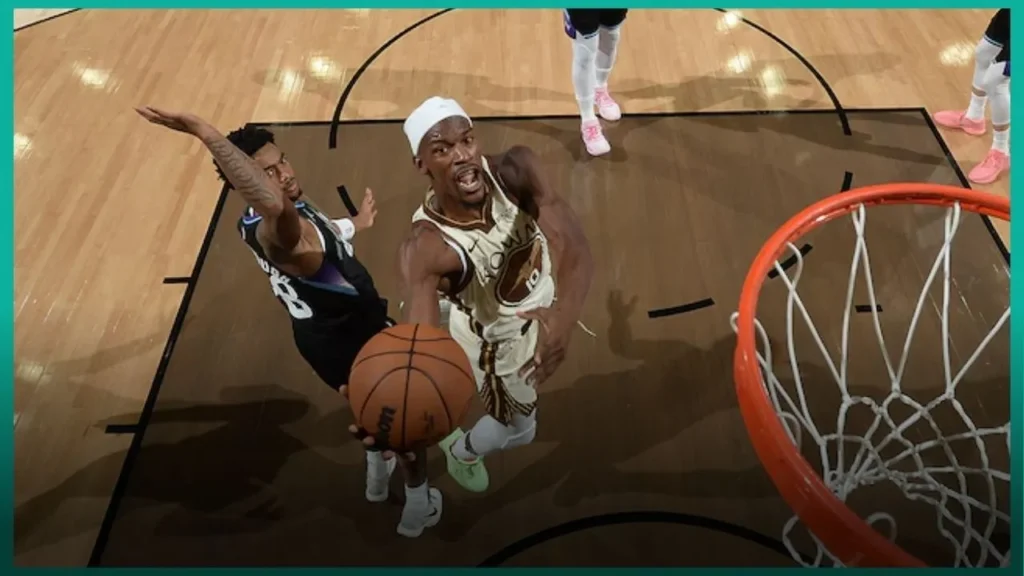
The Utah Jazz structured their offense around the versatile scoring abilities of Lauri Markkanen, whose performance was central to keeping the game competitive. Markkanen demonstrated an impressive blend of perimeter shooting, mid-range accuracy, and effective drives to the basket, making him a constant threat to the Warriors’ defense. His 27 points reflected a high level of efficiency and adaptability, as he adjusted his scoring approach based on defensive coverage and team needs. Markkanen’s ability to stretch the floor forced Golden State to extend their defense, which in turn created additional scoring opportunities for Utah’s supporting players.
Jordan Clarkson added another dimension to Utah’s offensive output with his dynamic scoring and playmaking from the backcourt. Clarkson’s ability to create his own shot under defensive pressure kept the Jazz competitive, especially during the second and third quarters. With 21 points and 5 assists, he not only contributed scoring but also facilitated ball movement, which is crucial when facing a team like Golden State that thrives on defensive disruption.
Walker Kessler provided Utah with a strong defensive presence in the paint, effectively challenging Golden State’s interior scoring attempts. His 11 rebounds and 3 blocks highlight his role in limiting second-chance points and protecting the rim. Kessler’s ability to dominate the defensive boards allowed Utah to reset offensively and contest high-percentage shots from the Warriors. Combined with Markkanen and Clarkson’s scoring, Kessler’s defensive work underscored Utah’s attempt to balance physical play with offensive execution, even in the face of a high-octane Warriors offense.
Stephen Curry’s Impact on the Warriors Offensive Strategy
Stephen Curry’s influence on the Warriors extends far beyond traditional scoring metrics, making him arguably the most critical player on the floor. His shooting range stretches defenses to unprecedented distances, forcing multiple defenders to account for his presence at all times. This spacing advantage allows other players to operate with greater freedom, creating open lanes for drives, cuts, and assists. In this game, Curry’s ability to quickly read defensive schemes and react accordingly was on full display, as he consistently found open teammates in optimal scoring positions.
Curry’s presence also changes the way opposing teams approach defensive rotations. Utah had to extend their coverage far beyond the three-point line, which opened up gaps in the paint and allowed Wiggins, Green, and Thompson to exploit mismatches. Beyond scoring, Curry’s decision-making fosters team cohesion, as he balances when to shoot and when to facilitate. This dual role maximizes the Warriors’ offensive efficiency and ensures consistent pressure throughout the game. His performance in this matchup demonstrated not only scoring brilliance but also his strategic importance in dictating the pace and style of the game.
Key Moments That Decided the Warriors vs Jazz Game
Several pivotal moments shaped the outcome of this contest, highlighting both team strategy and individual brilliance. One of the most significant sequences occurred during the third quarter, where the Warriors executed a series of consecutive three-point conversions. This scoring surge forced the Jazz to readjust defensively, which created open lanes and additional scoring opportunities for Golden State. These sequences often reflect a team’s ability to capitalize on momentum shifts and make tactical adjustments mid-game.
Another crucial moment came late in the fourth quarter when the Warriors secured multiple defensive rebounds, preventing Utah from generating second-chance points. This not only protected their lead but also allowed Golden State to maintain offensive control in the closing minutes. Strategic defensive execution, including disciplined positioning and timely switches, showcased how crucial small details can determine outcomes in closely contested NBA matchups. These key moments underscored the Warriors’ ability to combine individual talent with coordinated team execution to win high-pressure games.
Shooting Efficiency and Three Point Performance Analysis
Shooting efficiency was a decisive factor in this matchup, particularly in three-point shooting, where the Warriors have historically excelled. Golden State converted a high percentage of long-range shots, leveraging Curry’s gravity on the floor and Thompson’s catch-and-shoot efficiency. Their ability to convert under defensive pressure ensured consistent scoring bursts, helping build and maintain a lead over Utah.
Utah, while competitive in shooting, faced challenges in matching the volume and efficiency of Golden State’s perimeter offense. Markkanen’s efforts were effective, but the Jazz struggled to create open looks consistently, demonstrating how crucial spacing and ball movement are in modern NBA offenses. The difference in three-point production ultimately contributed to the final point differential, illustrating how shooting efficiency can define high-level matchups.
Rebounds, Assists, and Defensive Stats Comparison
Rebounding statistics revealed that Utah slightly outperformed Golden State in terms of missed shot recoveries, which helped limit second-chance scoring opportunities for the Warriors. However, Golden State offset this through superior ball movement and assist numbers, which ensured higher quality scoring chances per possession.
Defensively, both teams recorded multiple steals and blocked shots, reflecting the intensity and focus of each squad. Green’s defensive versatility and Kessler’s rim protection were particularly influential, as they disrupted potential scoring opportunities and allowed their teams to transition efficiently from defense to offense. The combination of defensive discipline and effective rebounding highlights how teams balance multiple elements to remain competitive in the modern NBA.
Bench Player Contributions in the Warriors vs Jazz Match
Bench contributions often serve as the unsung heroes in NBA matchups, and in this game, both teams’ reserves played pivotal roles. Golden State’s bench provided essential scoring support, ensuring that the team maintained offensive rhythm when starters rested. Their contribution helped sustain pressure on Utah’s defense and minimized scoring lulls that could have allowed the Jazz to close the gap.
Utah’s bench offered defensive energy, rebounding support, and secondary scoring, which kept the Jazz competitive throughout the game. Although not as prolific in scoring, these contributions were critical in maintaining team balance and enabling rotations that preserved starter energy. In high-stakes contests, such bench depth is often the difference between maintaining competitiveness and allowing opponents to dominate.
Turnovers and Defensive Stops Analysis
Turnovers played a crucial role in shaping the momentum of this matchup. Golden State’s lower turnover count allowed the team to maximize scoring opportunities and maintain offensive efficiency. Fewer turnovers not only preserved possessions but also prevented Utah from exploiting transition opportunities.
Conversely, Utah’s turnovers, though minor in quantity, led to fast break opportunities for the Warriors, which Golden State converted efficiently into points. Defensive pressure, particularly from Green and Curry, created some of these mistakes, demonstrating how strategic defense can directly influence scoring. These plays highlight the importance of ball security in determining game outcomes and illustrate the intricate interplay between offense and defense.
Coaching Strategies and Game Adjustments
Coaching strategies were clearly visible in this matchup, as both teams made tactical adjustments to exploit each other’s weaknesses. Golden State emphasized quick offensive transitions, spacing, and perimeter shooting, leveraging their stars’ strengths. Utah focused on interior defense, rebounding, and balanced scoring, trying to counter the Warriors’ high-octane offense with physicality and structure.
As the game unfolded, coaches adapted by switching defensive assignments, adjusting offensive sets, and managing player rotations to maintain competitiveness. Golden State increased defensive pressure in the second half, while Utah attempted to slow the pace and rely on half-court efficiency. These strategic decisions often play a critical role in tight matchups and demonstrate the importance of coaching in modern basketball analytics.


Head-to-Head Team Comparison: Warriors vs Jazz
The contrast between Golden State and Utah is evident in both style and execution. The Warriors rely on speed, perimeter shooting, and fluid ball movement to create scoring opportunities. Their offense prioritizes spacing and off-ball movement to maximize efficiency, often overwhelming less versatile defenses.
The Jazz emphasize physicality, rebounding, and balanced scoring across multiple players. Their strategy focuses on creating high-quality possessions through structure and defense rather than pure pace. These differing philosophies produce matchups where statistical battles, such as shooting efficiency, rebounding, and turnovers, become the primary determinants of victory. Such contrasts make Warriors vs Jazz games compelling for analysts and fans alike.
Historical Matchups Between the Warriors and Jazz
Over the years, Warriors-Jazz matchups have been marked by strategic battles and standout individual performances. In past decades, Utah dominated with a structured, disciplined approach led by legendary players, while Golden State evolved from mid-tier contenders into a dynasty characterized by shooting excellence and star-driven tactics.
Analyzing historical matchups reveals patterns in scoring, defensive strategies, and clutch performances. These games provide valuable insights into how team identities, coaching philosophies, and player evolution affect outcomes. Each encounter contributes to the ongoing narrative of this intriguing NBA rivalry.
Players Who Have Played for Both the Warriors and the Jazz
Several NBA players have represented both franchises over the course of their careers. Derek Fisher is a notable example, bringing veteran leadership and playoff experience to both teams at different stages. Players who experience multiple team environments often bring unique perspectives, leadership qualities, and skills that influence team dynamics.
Movement between the Warriors and Jazz, whether via trades or free agency, has also highlighted the importance of adaptability and role versatility in the NBA. These shared experiences sometimes provide subtle strategic advantages for players who understand both organizational cultures.
Key Takeaways from the Warriors vs Jazz Game
The statistical breakdown underscores the importance of shooting efficiency, ball movement, defensive discipline, and individual contributions. Golden State’s ability to consistently generate open shots, maintain low turnovers, and capitalize on fast break opportunities ultimately determined the outcome.
Utah’s efforts in rebounding, interior scoring, and defensive coordination demonstrated resilience and competitiveness. While the Jazz fell short, their collective performance highlighted the team’s potential to challenge elite opponents when executing their game plan effectively.
What This Game Means for the NBA Season Standings
Every game in the NBA impacts team positioning and playoff trajectories. A Golden State victory strengthens their standing in the Western Conference, providing momentum and confidence for upcoming matchups. It also reinforces their strategic strengths and highlights areas for refinement in rotational depth and defensive schemes.
For Utah, the game serves as a learning opportunity, offering insights into areas requiring improvement, particularly perimeter defense and three-point efficiency. Despite the loss, the Jazz demonstrated they have the talent and versatility to compete at a high level, which bodes well for future games against top-tier opponents.
Conclusion
The matchup between the Golden State Warriors and the Utah Jazz delivered a compelling example of modern NBA basketball. Through a combination of efficient shooting, strategic adjustments, and standout individual performances, the Warriors secured a well earned victory.
Analyzing player stats from the game reveals how each athlete contributed to the overall narrative of the contest. From Stephen Curry’s scoring brilliance to Lauri Markkanen’s versatile offense, the game featured numerous highlights that demonstrated the skill and competitiveness of both teams.
As the NBA season continues, future meetings between these franchises promise to deliver equally exciting battles filled with statistical achievements and memorable moments.
FAQs
Why is Steph Curry not playing?
There are several possible reasons why Stephen Curry might miss a Warriors game. The most common reasons include minor injuries, scheduled rest during a busy NBA season, or recovery from previous physical strain. Teams sometimes rest star players to preserve their health for important stretches of the season or playoff preparation. When Curry is unavailable, the Warriors typically rely on other guards and forwards to handle scoring and playmaking responsibilities.
How to watch the Warriors Clippers game?
Fans can watch Warriors vs Clippers games through official NBA broadcasting partners such as national sports television networks or regional sports channels. Streaming platforms that provide live NBA coverage also allow viewers to watch games on mobile devices and computers. Additionally, the official NBA League Pass service offers international viewers access to live and replayed games throughout the season.
Who has played for Jazz and Warriors?
Several NBA players have represented both the Utah Jazz and the Golden State Warriors during their careers. One notable example is Derek Fisher, who played for both franchises at different stages of his career. Player movement through trades, free agency, and short term contracts often results in athletes gaining experience with multiple teams across the league.
Did the Warriors go 16:1?
Yes. During the 2017 NBA playoffs, the Golden State Warriors achieved one of the most dominant postseason runs in basketball history by finishing with a 16 wins and 1 loss record. This remarkable performance demonstrated the strength of their roster and established them as one of the most powerful championship teams in NBA history.
VISIT MORE : Circle Magazine