



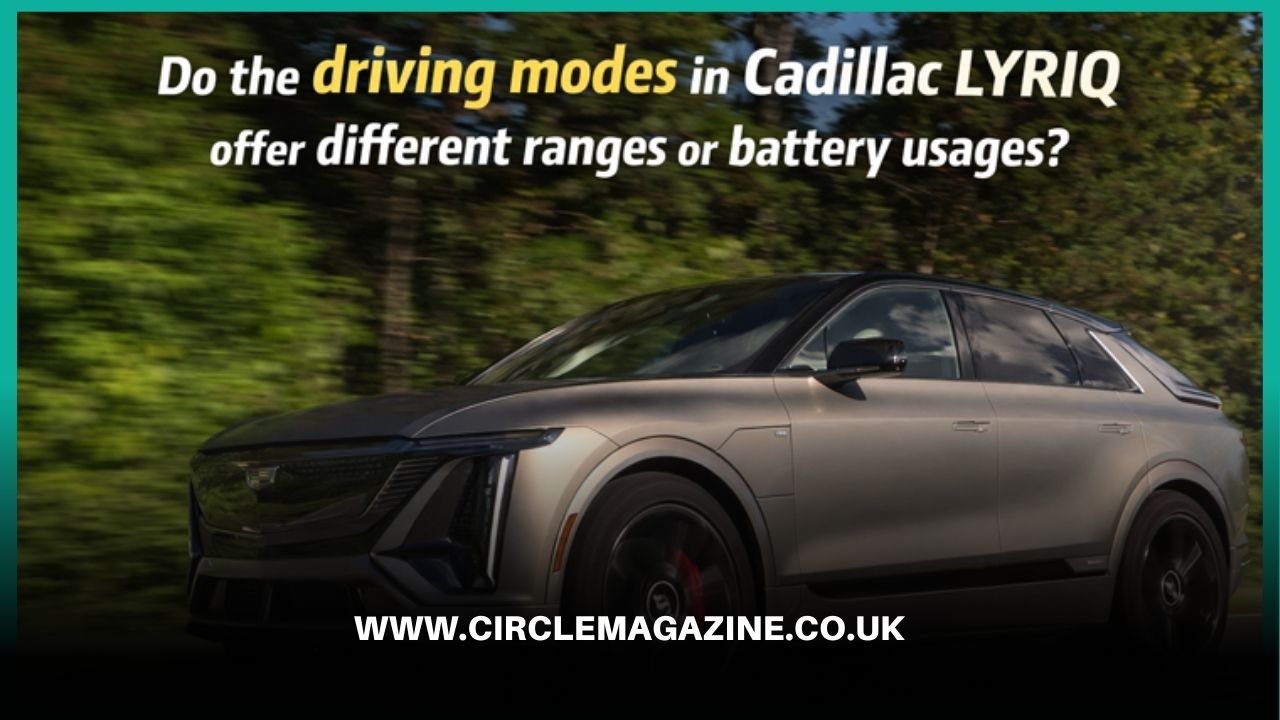
The question “Do the driving modes in Cadillac LYRIQ offer different ranges or battery usage?” is one of the most common concerns among electric vehicle buyers and current LYRIQ owners. As Cadillac’s first fully electric SUV, the LYRIQ offers multiple driving modes designed to balance efficiency, performance, comfort, and safety. However, many drivers want to know whether switching between Tour, Sport, Snow/Ice, and My Mode actually changes battery consumption or real-world driving range. Understanding how these driving modes influence energy usage is essential for maximizing range and getting the most out of the Cadillac LYRIQ.
This guide explores that question in detail. Rather than offering a simple yes-or-no answer, this article breaks down how each driving mode works, how it influences energy consumption, and how much difference it can realistically make to overall range. It also examines additional factors that interact with driving modes, such as driving style, weather, terrain, speed, and long-term battery habits. By the end of this guide, you will have a clear understanding of when driving modes matter most and how to use them effectively to balance performance, comfort, and efficiency in the Cadillac LYRIQ.
Understanding Driving Modes in the Cadillac LYRIQ
Before discussing range and battery usage, it is essential to understand what driving modes actually do in an electric vehicle like the LYRIQ. Driving modes are not just cosmetic settings; they change how the vehicle responds to driver inputs and how power is delivered from the battery to the electric motors.
In the Cadillac LYRIQ, driving modes adjust several vehicle systems simultaneously. These include throttle sensitivity, steering weight, regenerative braking intensity, traction and stability control behavior, and sometimes suspension tuning. While the battery capacity remains the same regardless of mode, how quickly energy is drawn from that battery can vary significantly depending on these settings.
The LYRIQ is designed to make these transitions seamless, meaning drivers can switch modes without harming the battery or drivetrain. However, the way the vehicle behaves in each mode can influence energy efficiency over time, especially during longer trips or repeated daily driving.
When asking do the driving modes in Cadillac LYRIQ offer different ranges or battery usage, it is important to understand how each mode adjusts throttle response, regenerative braking, and power delivery, as these elements directly influence energy efficiency.
Tour Mode: The Benchmark for Efficiency and Range
Tour mode is the default and most commonly used driving mode in the Cadillac LYRIQ. It is designed for everyday driving and aims to strike a balance between comfort, smoothness, and efficiency. From a battery usage perspective, Tour mode is the most efficient option for most drivers.
In Tour mode, throttle response is smooth and progressive. This means the vehicle delivers power gradually rather than aggressively, reducing sudden spikes in energy demand. Electric motors are most efficient when power delivery is steady, and Tour mode is tuned to encourage exactly that type of driving behavior. This directly contributes to lower battery consumption over time.
Regenerative braking is also more pronounced in Tour mode. When the driver lifts off the accelerator or applies the brakes, the LYRIQ converts kinetic energy back into electrical energy and stores it in the battery. Stronger regenerative braking allows the vehicle to recover more energy during deceleration, especially in city driving with frequent stops. Over the course of a full charge, this energy recovery can noticeably extend range.
For highway driving, Tour mode maintains consistent power delivery at cruising speeds. Since aerodynamic drag increases exponentially with speed, Tour mode’s relaxed acceleration helps avoid unnecessary energy loss. Under normal conditions, Tour mode allows the LYRIQ to come closest to its EPA-estimated range, assuming moderate speeds and smooth driving habits.
This is why many experts agree that when evaluating whether the driving modes in Cadillac LYRIQ offer different ranges or battery usage, Tour mode consistently delivers the best balance between efficiency and everyday comfort.
Sport Mode: Performance Comes at an Energy Cost
Sport mode is designed to make the LYRIQ feel more responsive and engaging. While it enhances driving enjoyment, it does so by prioritizing performance over efficiency, which naturally affects battery usage and range.
In Sport mode, throttle response becomes much sharper. Even small inputs from the accelerator pedal result in quicker power delivery from the electric motors. While this makes the vehicle feel more lively, it also increases energy consumption, particularly during frequent acceleration. Electric motors draw more power when delivering rapid bursts of torque, which leads to faster battery drain.
Steering feel is typically firmer in Sport mode, encouraging a more dynamic driving style. Although steering adjustments themselves do not consume energy, the more aggressive driving behavior that Sport mode invites often results in higher speeds and quicker acceleration, both of which increase power usage.
Regenerative braking in Sport mode is usually less aggressive than in Tour mode. This provides smoother transitions when slowing down at higher speeds but reduces the amount of energy recovered during deceleration. Over time, this reduction in energy recovery contributes to lower overall efficiency.
While Sport mode does not dramatically cut range in short bursts, consistent use can reduce total driving range by approximately 10 to 20 percent, depending on driving conditions and habits. For drivers who value performance, this trade-off may be acceptable, but it is not ideal for maximizing range on long trips.
For drivers wondering do the driving modes in Cadillac LYRIQ offer different ranges or battery usage, Sport mode clearly demonstrates how increased performance leads to higher battery consumption.
Snow/Ice Mode: Stability First, Efficiency Second
Snow/Ice mode is specifically designed for low-traction conditions such as snow-covered or icy roads. Its primary goal is safety and control, not efficiency or performance. As a result, its impact on battery usage is more situational.
In Snow/Ice mode, throttle sensitivity is reduced significantly. This limits how quickly power is delivered to the wheels, helping to prevent wheel spin. From an energy standpoint, this can reduce sudden power demands, which may seem beneficial for battery usage. However, the overall effect on range is not always positive.
Traction control and stability systems are more active in Snow/Ice mode. These systems constantly monitor wheel slip and adjust torque distribution to maintain grip. While these adjustments are necessary for safety, they can increase energy usage slightly due to continuous system engagement.
Additionally, driving in snowy or icy conditions often involves slower speeds, uneven traction, and increased rolling resistance. Cold temperatures also reduce battery efficiency. Even though Snow/Ice mode limits aggressive power use, real-world range often decreases because environmental conditions are working against the battery.
Therefore, Snow/Ice mode may prevent unnecessary energy waste caused by wheel spin, but it does not typically improve range compared to Tour mode. Its value lies in maintaining control rather than extending battery life.
My Mode: Customization and Its Impact on Battery Usage
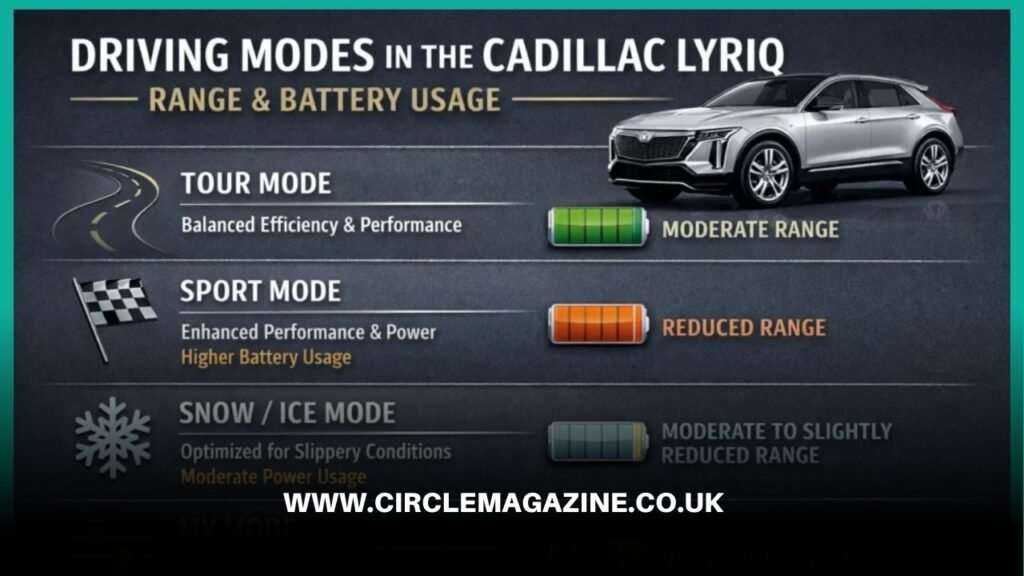
My Mode is one of the most flexible features of the Cadillac LYRIQ. It allows drivers to customize individual aspects of the driving experience, such as throttle response, steering feel, and regenerative braking strength. Because of this customization, the impact on range and battery usage varies widely.
If a driver configures My Mode with efficiency in mind, choosing softer throttle response and stronger regenerative braking, the vehicle can perform very similarly to Tour mode. In this configuration, battery usage remains relatively low, and range can be maximized.
On the other hand, if My Mode is set up for sportier driving with quick throttle response and reduced regenerative braking, battery consumption will resemble or even exceed that of Sport mode. The advantage of My Mode is that it allows drivers to fine-tune their preferences rather than committing to a fixed performance or efficiency profile.
This flexibility makes My Mode particularly useful for drivers who want different behaviors in different situations, such as a relaxed commute during the week and a more engaging drive on weekends. However, it also means that drivers must be mindful of their settings if maximizing range is a priority.
Quantifying the Impact of Driving Modes on Range
While exact range figures depend on many variables, it is possible to estimate how driving modes influence battery usage based on general electric vehicle principles and real-world driving patterns.
In optimal conditions, Tour mode allows the LYRIQ to achieve its best efficiency. For a configuration with an estimated range of around 300 miles, Tour mode driving with moderate speeds and smooth acceleration can come close to that figure. Energy consumption in this mode is typically lower per mile, making it ideal for long trips and daily commuting.
Sport mode increases energy consumption due to aggressive throttle response and reduced regenerative braking. Depending on driving intensity, range may drop by 30 to 60 miles on a full charge. Drivers who frequently accelerate quickly or maintain high speeds will see the most significant reductions.
Snow/Ice mode does not have a consistent impact on range. In mild winter conditions, battery usage may be slightly higher than in Tour mode due to traction system engagement. In severe cold, range reduction is more closely tied to temperature and road conditions than to the driving mode itself.
My Mode can either preserve or reduce range depending on how it is configured. Efficient settings can maintain near-Tour mode efficiency, while performance-oriented settings can significantly increase battery consumption.
Driving Style: The Most Important Factor Beyond Modes
While driving modes matter, driving style often has a greater impact on battery usage than mode selection alone. Aggressive acceleration, high-speed driving, and frequent hard braking all increase energy consumption, regardless of the chosen mode.
Smooth acceleration allows the electric motors to operate within their most efficient range. Maintaining consistent speeds reduces the need for frequent power adjustments, which helps conserve battery energy. Even in Sport mode, a gentle driving style can mitigate some of the increased energy usage.
Regenerative braking also plays a key role. Drivers who anticipate stops and allow the vehicle to slow down gradually can recover more energy, especially in modes with stronger regeneration. This behavior can extend range significantly in urban driving.
Speed and Highway Efficiency
Speed has a major impact on EV range due to aerodynamic drag. Driving at higher speeds requires exponentially more energy, which quickly reduces range. This effect is present in all driving modes but becomes more pronounced in Sport mode, which encourages higher speeds and quicker acceleration.
Tour mode is best suited for highway driving at moderate speeds. Maintaining a steady cruising speed between 60 and 65 mph typically offers the best balance between travel time and efficiency. Speeds above this range can reduce total driving range substantially, regardless of mode.
Weather and Temperature Effects
Temperature plays a significant role in battery performance. Cold weather reduces battery efficiency by slowing down chemical reactions within the battery cells. Hot weather increases energy usage due to cooling demands.
Driving modes cannot fully counteract these effects. However, Tour mode generally handles temperature-related efficiency losses better by minimizing unnecessary power draw. Preconditioning the battery while the vehicle is plugged in can help mitigate temperature-related range loss, especially in extreme climates.
Terrain and Elevation Changes
Hilly and mountainous terrain increases energy usage because climbing requires sustained power from the battery. While regenerative braking can recover some energy during descents, it does not fully offset the energy used during climbs.
Tour mode helps manage power delivery more efficiently on inclines, while Sport mode may encourage stronger acceleration uphill, increasing energy consumption. Terrain-related range loss is unavoidable, but efficient driving modes can help reduce its impact.
Long-Term Battery Health and Efficiency
Driving modes do not directly harm the battery, but long-term habits can influence overall battery health. Consistently driving aggressively and frequently charging to 100 percent can contribute to faster battery degradation over many years.
For daily use, keeping the battery charge between 20 and 80 percent is generally recommended. Using efficient driving modes like Tour mode for routine driving can also help reduce thermal stress on the battery, supporting long-term health and consistent range.
Practical Tips for Maximizing Range in the LYRIQ
To get the most out of the Cadillac LYRIQ’s battery, drivers should consider combining efficient driving modes with smart habits. Choosing Tour mode for daily driving, maintaining moderate speeds, using regenerative braking effectively, and preconditioning the battery when possible all contribute to better efficiency.
My Mode can be customized for efficiency if drivers want a personalized alternative to Tour mode. Sport mode should be reserved for situations where performance is the priority rather than range.
Conclusion
Yes, the driving modes in the Cadillac LYRIQ do offer different ranges and battery usage characteristics, but the differences are best understood in context. Tour mode is the most efficient and offers the longest range under most conditions. Sport mode provides enhanced performance at the cost of increased energy consumption. Snow/Ice mode prioritizes safety and stability, with range influenced more by environmental factors than by the mode itself. My Mode offers flexibility, allowing drivers to choose between efficiency and performance based on personal preferences.
Ultimately, driving modes are just one part of the efficiency equation. Driving style, speed, weather, terrain, and charging habits all play crucial roles in determining real-world range. By understanding how these factors interact, LYRIQ owners can make informed choices that balance comfort, performance, and efficiency.
So, when answering the question do the driving modes in Cadillac LYRIQ offer different ranges or battery usage, the clear conclusion is that driving mode selection does influence efficiency, but overall range still depends heavily on driving habits and conditions.
Frequently Asked Questions (FAQs)
Does switching driving modes damage the Cadillac LYRIQ battery?
No, switching driving modes does not damage the battery. The vehicle is designed to handle mode changes seamlessly without affecting battery health.
Which driving mode gives the best range in the Cadillac LYRIQ?
Tour mode generally provides the best range because it prioritizes smooth power delivery and strong regenerative braking.
How much range can Sport mode reduce?
Sport mode can reduce range by approximately 10 to 20 percent, depending on driving style and conditions.
Is My Mode better than Tour mode for efficiency?
My Mode can match Tour mode efficiency if configured properly, but it can also consume more energy if set up for performance.
Does Snow/Ice mode save battery power?
Snow/Ice mode limits aggressive power use but does not necessarily improve range, as cold temperatures and traction demands often reduce efficiency.
Can driving habits outweigh the impact of driving modes?
Yes, aggressive acceleration, high speeds, and frequent hard braking can reduce range more than mode selection alone.
VISIT MORE : Circle Magazine